Showing posts with label geek. Show all posts

13 November 2010

Batmen Down the Years

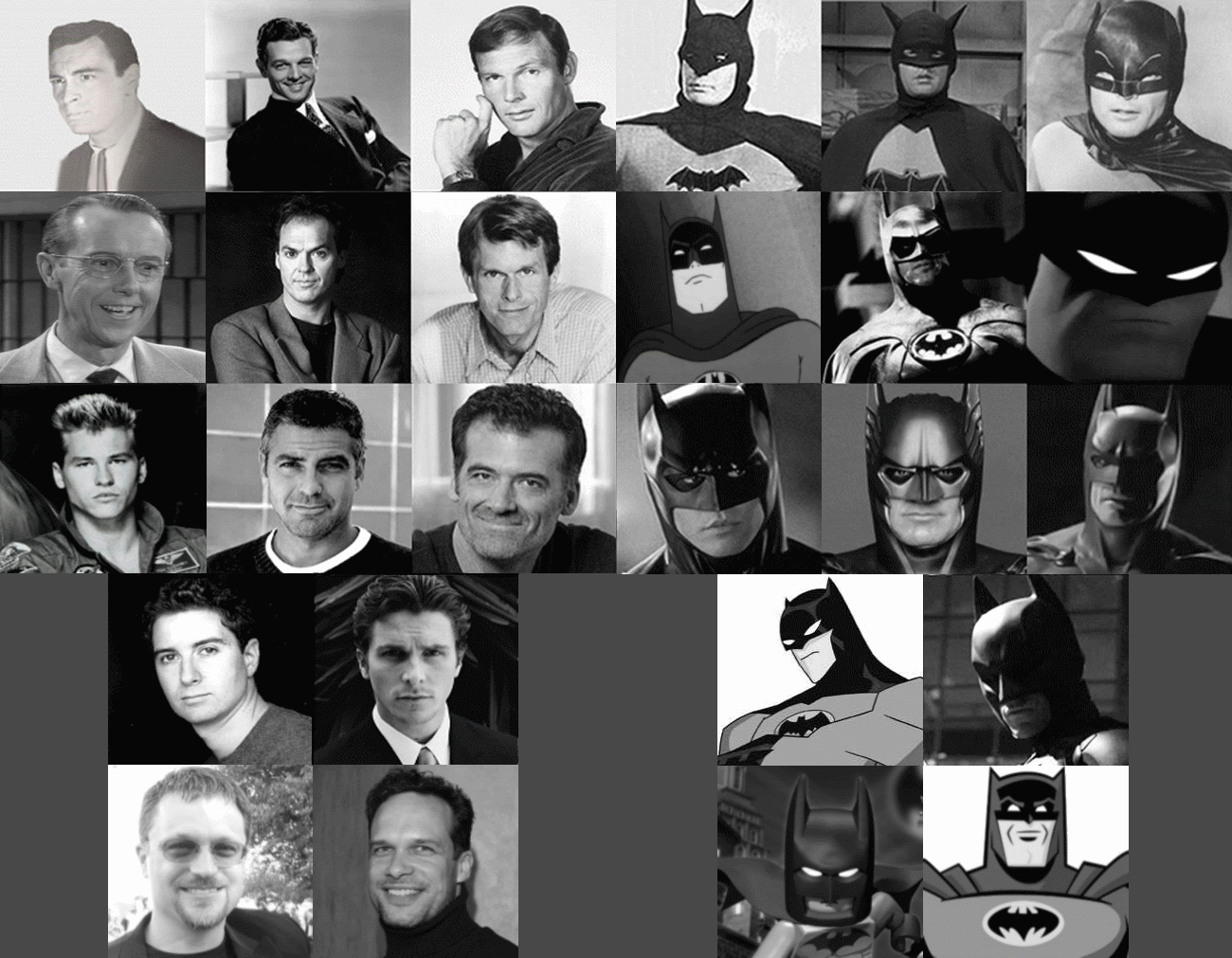
From Geeks Are Sexy's post The Many Faces of Batman I found my way to Blame It on the Voices' Batmen post, a cool picture of the various actors who have portayed Batman over the years, juxtaposed with their respective incarnations of him.

But, I noticed a few missing. So even though my picture editing skills aren't all that great, I decided to take what they had and update it with the missing Batmen.


The names:
  • 1. Lewis Wilson (Batman, 1943)
  • 2. Robert Lowery (Batman & Robin, 1949)
  • 3. Adam West (Batman, 1966-1968)
  • 4. Olan Soule (The Batman/Superman Hour, Super Friends 1968 - 1983)
  • 5. Michael Keaton (Batman, Batman Returns, 1989 - 1992)
  • 6. Kevin Conroy (Batman: The Animated Series, Batman: Mask Of The Phantasm, Justice League, Batman Beyond & Batman video game series 1992 - Current)
  • 7. Val Kilmer (Batman Forever, 1995)
  • 8. George Clooney (Batman & Robin, 1998)
  • 9. Bruce Thomas (Batman Onstar Commercials, Birds Of Prey, 2000-2002)
  • 10. Rino Romano (The Batman 2004 - 2008)
  • 11. Christian Bale (Batman Begins, The Dark Knight, The Dark Knight Rises, 2005 - 2012)
  • 12. Steven Blum (Lego Batman: The Video Game 2008)
  • 13. Diedrich Bader (Batman: The Brave and the Bold 2008 - Current)

Be sure to head back to Blame It on the Voices to vote for your favourite incarnation of Batman.

09 September 2010

Ultimate Chess


I was Looking through some of my old notebooks earlier and I found this copy of the rules of Ultimate Chess, a variation on that classic game which I had written years ago. I had written this to have a challenge for my geek friends whom I played chess with from time to time. This is a 4 player version of chess which we found enjoyable at the time, so I'll share these rules and changes for anyone who wants them.

Rules of Ultimate Chess


Ultimate Chess is played with four players. As in Classic Chess, before the start of the game, the players must decide which color pieces they will play Black, Red, Green or Silver. Silver makes the first move followed by Red, Black and Green.

Setting up the ULTIMATE CHESS board:

The Ultimate Chess board has 192 squares with a 12 x 12 square battle field and four 12 x 2 staging fields, placed at each side. It is important to realize that in the course of the game these staging fields are part of the board and can be occupied by any piece.

Position the board so that a dark corner square is on the right-hand side of each player. Each of the player's Mages are placed on the corner squares of the first row of their staging field. Next place the Warriors on the squares next to the Mages, followed by the Rooks, Knights and Bishops. Then the Queen is placed on the square matching her own color (Green Queen on Black and Red Queen on Silver) and the King is placed beside the Queen. One Pawn is placed on the row of squares in front of each piece.


The Object of the Game:

The object of the game remains the same as in Classic Chess; to checkmate the opposing Kings. When a King is directly threatened by an opponent's piece, the King is in check. The player in check must respond in one of three ways. He must either:
1. Capture the threatening piece,
2. Block the path of the threatening piece or,
3. Move the King to a un-threatened square

Checkmate occurs when a player's King is in check and the player has no way to get out of check on the next move. This ends a stage with the capturing player as the victor. Game Play continues in one of three ways until 3 players have been defeated, leaving one player the clear winner.

In a "Standard" game the defeated player will remove any of his remaining pieces from the board and play will continue as normal.

In a "Conquest" game, if the defeated player has any remaining pieces they are left on the board as obstacles.

In a "Devastation" game the victor takes control of the defeated player's pieces, which he may opt to move during his normal moving phase instead of one of his own pieces. In "Devastation" play the victor retains only one moving phase after defeating another color.

A game of chess can also end in a draw in which there is no clear winner. A draw may occur one of four ways:
1. Stalemate: A stalemate occurs if a player who is not in check cannot move any piece, including the King, without placing their King in check.
2. Insufficient Mating Material: When neither player has the pieces needed to checkmate the other player. E.g. Bishop and King vs. King.
3. Threefold Repetition of Position: The game is drawn if the same position (with the same person on move) has appeared on the chessboard three times.
4. 50 Moves Rule: If there have been 50 consecutive moves of each color without any piece capture or any pawn move.

If a player feels that their position is hopeless, the player may end the game by conceding to the another player. Alternatively, if the players feel that no side can win, they may agree to a draw.

How The Pieces Move and Capture:

All Chess pieces capture an opponent's piece by landing on the square occupied by the opponent's piece.

From its initial position, a Pawn in Ultimate Chess can move one, two or three squares forward and after that the Pawn can move "forward" only one square at a time. Forward being one space directly in front, to the left or right, of its starting position. A Pawn cannot move one square initially and then two squares afterward. When making an initial double or triple move a Pawn cannot jump over other pieces. While Pawns move directly forward, they can only capture an opposing piece by moving one square forward diagonally. When a Pawn reaches the far side of the board it is immediately promoted to any piece except a King. The principle for capturing an opposing Pawn en passant is not present in Ultimate Chess. (En Passant: If a Pawn moves two or three squares initially and passes an opposing Pawn on the fourth or fifth rank, the Pawn may be captured en passant. The opposing Pawn moves onto the square through which the Pawn moved.)

The King, Queen, Bishop, Knight and Rook move and capture in the same way as Classic Chess. Virtually nothing about chess has changed with Ultimate Chess.

The King can move one square in any direction, except when castling. Castling is a defensive move using the King and either Rook. A player can castle provided that:
1. The King is not in check.
2. The King and the castling Rook have not been moved during the game.
3. All the squares between the King and the castling Rook are unoccupied.
4. The King would not be moving through or landing on a square under threat.
When Castling, the King either moves two squares towards the King's Rook, or the King move two squares towards the Queen's Rook. The King's Rook or Queen's Rook then moves to the square the King moved through.

The Bishop is a line piece which moves in an unobstructed path any number of squares diagonally. A Bishop only occupies squares of its starting color.

The Rook is also a line piece. It moves in an unobstructed path any number of squares orthogonally (horizontally or vertically).

The Queen is the most powerful classic chess piece, combining the powers of the Bishop and the Rook. It moves along an unobstructed path any number of squares diagonally or orthogonally.

The Knight is a leaper. Unlike a line piece it doesn't require an unobstructed path to move along and it can jump over other pieces. The Knight can move two squares horizontally or vertically and then one square to either side.

The Ultimate Chess Pieces:

The Warrior, like the Knight, is classified as a leaper. It can move one square orthogonally, forward, backward or to either side. Or the Warrior can jump two squares forward or backward or to either side, or jump two squares diagonally in all four directions. The Warrior can jump over pieces and it can control up to twelve squares. The Warrior cannot move one square diagonally.

The Mage is also classified as a leaper. It can move one square diagonally in all four directions. Or, like an exaggerated Knight move, the Mage can jump three squares horizontally or vertically and then one square to either side. The Mage is bound to the color of its starting square. The Mage can jump over pieces to also control up to twelve squares.

29 July 2010

Ebooks and things


The new even lower priced Kindle has me thinking about ebooks again.

I think one of the big breakthroughs on ebooks becoming a more mainstream form of consumption will be lower priced readers, 99$ seems like the sweet spot. Kind of like when personal music players got less expensive they hit the mainstream and became ubiquitous.

The second element that I would hope for is a more sensible price range for ebooks themselves. There's no good reason, in my opinion, for one to cost more than 7.99$. Some people seem to think that ebooks should be priced lower since they don't have the dead-trees to pay for. A good argument but they take too far. In response others will point out that ebooks still take writing and editing and all that other behind the scene stuff that books will need no matter the format. But I look at the Mass-Market Paper-Back style, the majority of MMPBs cost around 7.99$. MMPBs still need writers and editors and all the rest and that price pays for them all and the dead-trees. And, lets be honest here, it would pure incompetence for web hosting and bandwidth to cost more than the dead-trees.

But then, people are perfectly willing to over-pay for MP3 files compared to music CDs. Even when CDs came down to 9$ or 10$ people were still paying 0.99$ per song, typically in the range of 12$ or more per CD's worth music. Maybe everyone will just get used to being price gouged for ebooks. Well, everyone else that is. I'll stick to collecting my dead-tree if I'm going to be paying the same price anyway.

Now the real magic will be when I walk into a book store, or log onto Amazon, and buy a dead-tree book, I'll get some kind optional upgrade which will furnish me with a special code I can use to also download a deeply discounted ebook and audio-book file of the same title. Add to this a specialized ebook and audio-book hybrid file which my reader will sync with. I can read the ebook when I need to, and have it automatically switch to narrating to me, say when I'm driving or something else. Now that would be something that would entice me into the market.

10 April 2009

Spring

Spring has finally started springing around here. Slowly started warming up and flowers are blooming.

I'm currently reading Amberville, by Tim Davys, which is absolutely awesome. Seriously. Its a noir thriller about stuffed animals. If you haven't read it yet, find it and do so.

Otherwise not much else going on. Have a great spring, it'll probably be another few months before I remember to update this journal again. ^_^

  • Mood: Optimism
  • Listening to: This is Unstoppable by E.S Posthumus
  • Reading: Nicholas Ostler's Ad Infinitum: Biography of Latin
  • Drinking: Coffee


  • [Oringinally posted on my deviantArt journal]

    29 August 2006

    Thoughts on the recent IAU debacle regarding Pluto and the other planets


    My thoughts on the recent IAU debacle regarding Pluto and the other planets ... oh come on raise your hands if you really expected this geek not to eventually comment on how badly they dropped the ball? There now, that's what I thought...

    All right first of all they had a golden opportunity to set down some good grounded scientific definitions which would be universal and well serve humanity on our first steps into the stars. Boy did they blow it. The condescending elitists of the astronomical community accuse those of us with some sense of sentimentality simply because we wanted Pluto to maintain its rightly deserved status of a planet. They will claim that we wanted it to stay the way it was because Pluto has been a planet since its discovery in 1930. However I suggest that matters are very reversed, that the entrenched elitists who pushed this "definition" through were violently opposed to the re-re-naming of the planet Ceres (which was named a planet upon its discovery in 1801 and only demoted to "asteroid" about 50 years later) as such and including the new planet, provisionally named, 2003 UB 303 as such. The elitists own deep entrenched sentimentality drove them to fear the rightly additions to our own solar system and fight to adopt a flawed definition of the term planet which will only serve to cause greater debate and confusion at later dates as we finally move towards a greater understanding of our neighboring systems when we find other smaller planets.

    What I propose in remedy of this unfortunate mismanagement and to (hopefully) further prevent any future confusion and debates, I suggest nothing short of a complete reassessment of the celestial sphere.

    We will start with an examination of the term "planet" itself. The term planet itself comes from an ancient Greek word meaning wanderer. Which meant any light in the sky that didn't move in a regular and easily predictable pattern across the sky, which the stars do. The "planets" compared to the relatively stable pattern and position of the stars do seem to wander. However given the ancient view of the world which gave rise to this term both the Sun (Helios/Sol) and the Moon (Luna) were also considered to be "planets" along with Mercury, Venus, Mars, Jupiter, and Saturn. Given the rise of the heliocentric model of our solar system and more modern understandings of astronomy Luna was demoted to be a moon and Helios promoted to being a star, along with the Earth (Terra) being demoted from the center of the universe to a wanderer following our star around. Then we built telescopes and started finding way too many other bodies out there wandering around our star. Clearly a better system of classification was and still is needed.

    So we keep the term planet for the primary wanderers around our star. That's fine, there's a sense of classicism there, everybody is familiar with the idea of a planet. So lets define planet so everybody is on the same page. The IAU started out fairly good but they fumbled at the goal line.

    "Is not massive enough to initiate thermonuclear fusion of deuterium in its core..." good start, if it can do that its a star not a planet, I think we all agree.

    "Has sufficient mass for its self-gravity to overcome rigid body forces so that it assumes a hydrostatic equilibrium (nearly round) shape..." that's a good one too, however one has to wonder what the definition of "nearly round shape" is? Is a body with 3% derivation from a perfect sphere nearly round, is one that's 30% derivation?

    "Is in orbit around a star or stellar remnants..." that's where we really start to slip. There are bodies out there orbiting other massive planets that are far more massive than some bodies which are simply orbiting a star. If we're using physical characteristics to determine our definition then this seems fairly arbitrary and could be improved on.

    "Has cleared the neighborhood around its orbit..." and of course this is where we all know that everything went from needs some polishing to OMG! You bastards killed Pluto! This is ball dropping low-light of the game. Where the IAU had a chance to categorically change the way we think about our solar system and others they let a few sniveling little whiners, who have a grudge against 2003 UB 313 just because some well meaning flakes call it Xena, hold them back and ruin a good thing they had going. Here the IAU had a shining chance to create a new broad and sweeping definition of the term planet that would include all obviously planetary bodies and then could further refine the broad category into smaller more specific classifications. Why are Mercury and Jupiter in the same class but Mercury and Ceres not? There is no reason. They should all be planets in the massive grouping, but each belonging to its own subcategory. Planetary astronomy could have taken the nod from taxonomy and developed a categorical classification system in which things with a few vague similarities are broadly classed together and then sifted out into their own unique sub-grouping based on more and more specific criteria. But they didn't ... and now the universe is a muddle.

    Of course we'd also like to point out that Mars, Jupiter, Neptune and even Earth all have asteroids as neighbors. Jupiter itself has 50,000 Trojan asteroids, I wouldn't call that a clear neighborhood. So I guess Jupiter is now the biggest dwarf planet, seems silly doesn't it? But according to IAU's new rules Jupiter is now Ceres dwarf planetary buddy.

    Our proposed new definitions are as follows:
    * Galaxy, a huge gravitationally bound system of stars, interstellar gas and dust, plasma, (possibly) unseen dark matter, and other matter.

    * Blackhole, an object predicted by general relativity with a gravitational field so strong that nothing can escape it, not even light. Formed in nature whenever a sufficient amount of mass gets packed in a given region of space, through a process called gravitational collapse.

    * Star, any body large enough to have at one point in its life cycle supported a sustained natural fusion reaction for an extended period of time, that is not a Blackhole.
    * Primary Star, any star around which another star orbits, or which is the only star in its system.
    * Binary Star, any set of two stars where the center of gravity in their system is not inside one of the bodies but is in the space between them.
    * Secondary Star, any star that is in orbit around another star where the center of gravity in that system is within the body of the larger star.

    * Planet, any body not large enough to sustain a natural fusion reaction for an extended period of time AND had sufficient self-gravity to overcome rigid body forces so that it assumes a hydrostatic equilibrium (nearly round) shape, within a 20% derivation from a perfect sphere.
    * Jovian Planet, a large planet that is not primarily composed of solid matter, but will most likely have a rocky or metallic core, while the majority of its mass is in the form of gas (or gas compressed into a liquid state).
    * Telluric Planet, a planet that possess a secondary atmosphere, an atmosphere generated through internal volcanism or comet impacts.
    * Chthonian Planet, a planetary object resulting from the stripping away of a Jovian Planet's atmosphere. Such atmospheric stripping is a likely result of close proximity to a star.
    * Mesoplanet, a Planet of sufficient size for its self-gravity to overcome its rigid body forces and become nearly round, yet not of great enough gravity to maintain an atmosphere in non-proximity to a star.
    * Binary Planets, any set of two planets where the center of gravity in their systems is not inside one of the bodies but is in the space between them.
    * Secondary Planet, any planet that is in orbit around another planet where the center of gravity in that system is within the body of the larger planet.

    * Planetoid, any body with sufficient self gravity to nearly overcome its rigid-body forces so that it assumes a nearly round shape between 21% and 40% derivation from a perfect sphere.
    * Cluster Planetoid, any group of planetoids where the center of gravity of the group is not in any of the bodies but in the space between them.
    * Secondary Planetoid, any planetoid that is in orbit around a larger planet or planetoid where the center of gravity in that system is within the body of the larger object.

    * Asteroid, a predominantly rocky body orbiting a star that is smaller than a planet or planetoid such that its own self-gravity cannot overcome its rigid-body forces.
    * Cluster Asteroids, any group of asteroid where the center of gravity of the group is not in any of the bodies but in the space between them.
    * Secondary Asteroid, any asteroid that is orbit around a larger solar system object, which is not a star, where the center of gravity for the system is within the larger object.

    * Moon, any body which is in orbit around a planet and not a star, including other Planets, Planetoids, or Asteroids.

    A logical derivation of terms not too far different from what we have come to learn and expect from our solar system and from others. While very closely related to current definitions and propositions we feel that this system is much more flexible and able to cope with new and coming discoveries of celestial bodies in ours and other systems.

    [originally posted on my MySpace Blog]